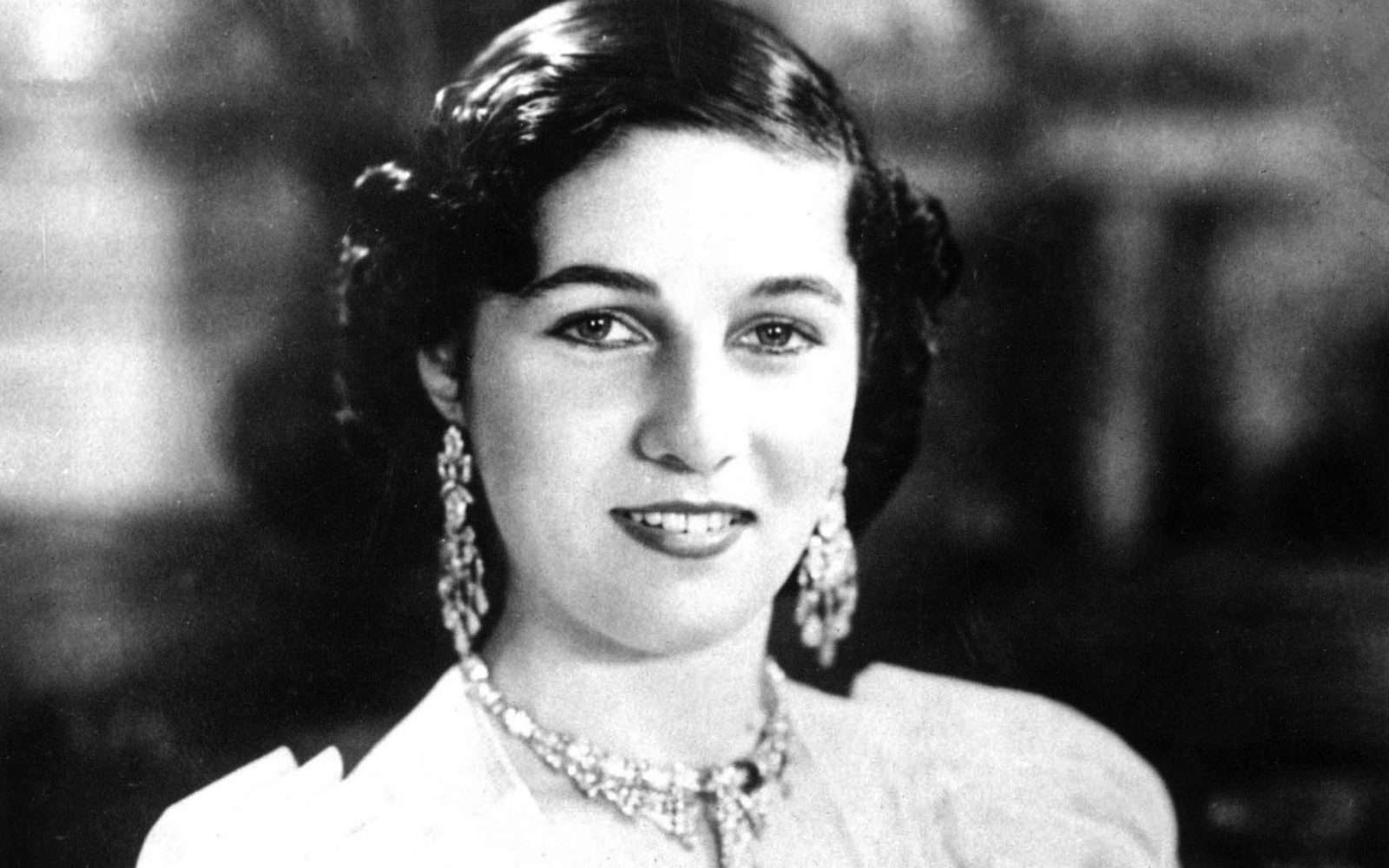
Princess Fawzia Fouad, daughter of King Fouad I of Egypt and first wife of Emperor Mohammed Reza Pahlavi of Iran, was not only one of the most beautiful princesses of the Alawite family – perhaps the most beautiful of all – but also one of the most elegant and fashionable women of her time. The British ambassador to Egypt at the time, Sir Miles Lampson, famously said of her: “I saw in her the most beautiful woman on earth.” Looking at her photos and her stunning beauty, we can’t help but feel that he was absolutely right!

On her birthday, November 5, 1921, Moget wanted to shed some light on the life of Princess Fawzia, or the Sad Princess, as she was nicknamed by some, the turning points in her life and her most famous and most beautiful looks.
Princess Fawzia Fouad was born in Ras al-Tin Palace in Alexandria on November 5, 1921, and is the second daughter of King Fouad I and Queen Nazli Sabri. She was a member of the Muhammad Ali dynasty, a family of Albanian origin. Her lineage also included French and Circassian heritage through her maternal side. After King Farouk, she was followed by Princesses Fayza, Faika, and Fathia, but she was the closest to King Farouk, and she is also the granddaughter of Khedive Ismail, during whose reign Egypt became a piece of Europe. Fawzia was educated in Switzerland and was fluent in Arabic, English, and French.


Princess Fawzia was proposed to by the Crown Prince of Iran at the time, Prince Mohammad Reza Pahlavi, and a legendary wedding was held in Cairo on March 16, 1939, when the princess was only 18 years old. This marriage was largely a political alliance, orchestrated to strengthen ties between Egypt and Iran. Another ceremony was held in Tehran upon the couple’s arrival from Cairo to the Iranian capital, and is said to have lasted for three days.


Two years after the marriage, Mohammad Reza Pahlavi was installed as the Shah of Iran and Princess Fawzia became Empress of Iran (though the title of “Empress” was not formally used in Iran until later; she was known as Queen Fawzia during her tenure), but the marriage did not last long, as she lived a sad period of her life during which she was unable to adapt to her new life in Tehran. She found the Iranian court more conservative and less cosmopolitan than Cairo, and reportedly had strained relationships with her mother-in-law and sisters-in-law, even facing public unfaithfulness from the Shah.
She was reportedly treated for depression starting in 1944. So she returned to Cairo after a difficult period of suffering and decided to divorce in 1945. The marriage resulted in her only child with the Shah – Shahnaz – who was born in October 1940. The divorce was an Egyptian one, and it was not fully recognized by Iran until November 17, 1948. A key condition was that Princess Shahnaz would be raised in Iran.


In March 1949, she married Colonel Ismail Shirin, who was Minister of War before the July 1952 revolution, with whom she had a daughter, Nadia, in 1950 and a son, Hussein, in 1955. This second marriage was widely described as a happy and loving union, offering her the personal fulfillment she had sought.

She was keen on developing shelters, visiting hospitals, volunteering in charitable work, providing in-kind and financial assistance to the needy. While in Iran, she led the newly founded Association for the Protection of Pregnant Women and Children (APPWC). After returning to Egypt, she headed the Mabaret Mohamed Ali charity organization. She even volunteered as a nurse in the Egyptian army during the Palestine War to serve the injured.
After the revolution of July 23, 1952, the princess remained in Alexandria, the city where she was born, until her death on July 2, 2013, at the age of 91. Her passing was notably quiet, receiving little public attention due to concurrent major political events in Egypt.