
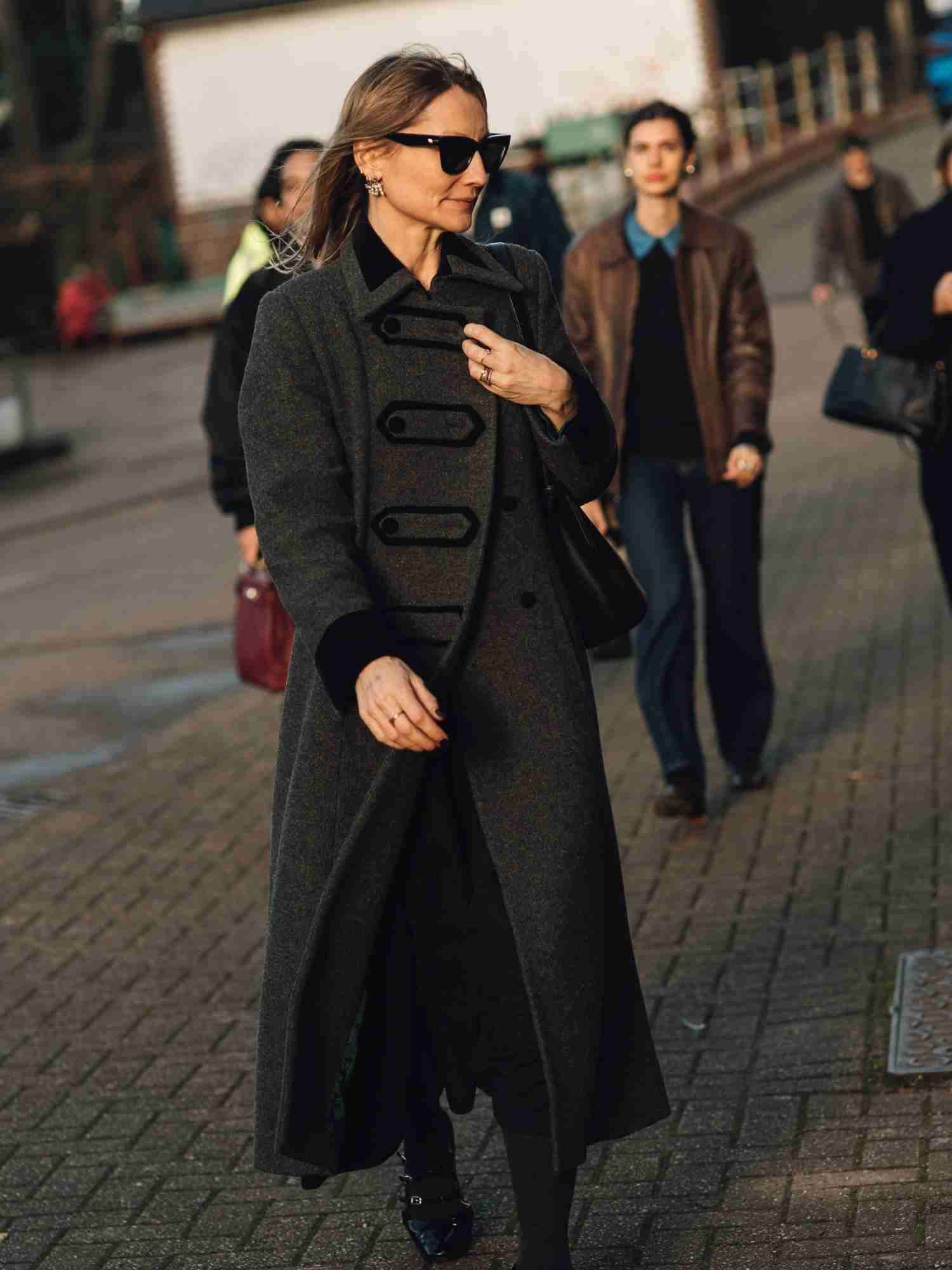
The toggles on a duffle coat are oversized because they had to be fastened by a hand in a glove. Most types of coats work this way: the feature you recognise began as the answer to a problem, and the problem still explains the design. The twelve worth knowing are the Chesterfield, Crombie, covert coat, wrap coat, trench, mac, peacoat, duffle, car coat, parka, puffer and shearling, and two things separate them, how far down the body they run and how they close. Each is named below, placed on a body and put to work, with advice on which to buy first.
What Is the Difference Between a Coat and a Jacket?
A jacket traditionally stops at the hip, while a coat falls past it, to mid-thigh, the knee or lower.
Length is the line most makers draw, and tailoring vocabulary backs it up: the jacket that matches your trousers is a jacket, and whatever goes over it is a coat. Warmth blurs the rule. A down jacket insulates better than an unlined trench, and the peacoat is a coat that ends at the hip.
Use length as the guide and the job as the tiebreaker. A coat is made to be worn over other layers, including a jacket, and a jacket is never worn over a coat.
Length and Closure Identify Almost Every Coat
Length tells you how formal and how warm a coat is, and the closure tells you what it was built to do.
Read length first. Hip-length coats, such as the peacoat and the duffle, sit well with trousers and knitwear. Mid-thigh, where the car coat and the Crombie finish, is the working middle. Knee-length is the formal line and the Chesterfield’s length, and anything below it reads as a statement.
Then read the closure. Single-breasted fronts are the quietest. Double-breasted fronts, as on the trench and the peacoat, add width across the chest. A belt and no buttons marks a wrap coat, toggles mark a duffle, and a zip under a storm flap marks a parka. Trade usage adds one more term: a topcoat is a lighter overcoat cut for spring and autumn, and covert coats are usually counted as topcoats.
The Main Types of Coats at a Glance
There are twelve coats worth knowing by name, and each answers a different kind of day.
They run here from the most formal to the most practical.
- The Chesterfield is a knee-length, single-breasted overcoat with a velvet collar, cut for suits and formal evenings.
- The Crombie is a shorter, softer-shouldered tailored overcoat for working weeks.
- The covert coat is a lighter topcoat in hard-wearing twill, marked by rows of stitching.
- The wrap coat closes with a belt instead of buttons and favours movement over structure.
- The trench is a belted, double-breasted gabardine coat for wet shoulder seasons.
- The mac is a plain, fully waterproof coat for proper rain.
- The peacoat is a short, double-breasted wool coat taken from naval workwear.
- The duffle is a hooded wool coat fastened with toggles.
- The car coat sits at mid-thigh and is cut to be worn seated.
- The parka is a hooded, insulated coat for wind and wet cold.
- The puffer coat is quilted and filled with down or a synthetic equivalent.
- The shearling coat is sheepskin worn with the wool on the inside.
Formality falls as the list goes on, and protection against weather climbs.
Tailored Overcoats That Sit Over a Suit
A tailored overcoat is cut to fit over a jacket, which makes it the most formal type of coat and the one most worth getting right.
The shoulder is the reason. Once a sleeve head is set, a tailor cannot move the shoulder line without rebuilding the top of the coat, so the choice between bespoke or made-to-measure matters more here than on a casual piece. Try overcoats on over the thickest jacket you own, and check that the sleeves clear the jacket cuffs.
The Chesterfield Coat for Formal Evenings
The Chesterfield is a single-breasted, knee-length overcoat with a velvet collar and no seam at the waist, so the line drops straight from shoulder to hem. It takes its name from an Earl of Chesterfield and is usually cut in navy or charcoal, in wool or a wool and cashmere blend. It suits anyone who wears tailoring regularly, and it is the coat for black tie, where it covers a dinner jacket without disturbing it. Wear it over a power suit as readily as over evening dress, with black Oxfords and empty pockets, because anything that bulges spoils the line.
The Crombie for Everyday Tailoring
The Crombie is a single-breasted wool overcoat that finishes at the thigh, with soft shoulders, a velvet top collar and concealed buttons. It takes its name from Crombie, the British house that began as a cloth producer in 1805, and the name now covers the whole style. It is shorter and less formal than a Chesterfield, so it suits anyone in a suit four days a week and in trousers and knitwear on the fifth. Wear it buttoned over a collared shirt and let the velvet collar be the only decoration.
The Covert Coat for Country Cloth in the City
The covert coat began as a riding and hunting coat, with a deep centre vent for the saddle, and it is cut from covert cloth, a light, hard-wearing twill in greenish or reddish brown. Rows of contrast stitching along the hem and cuffs are its signature. It is lighter than a classic overcoat and counts as a topcoat, which makes it a sensible choice for spring, autumn and mild winters. It suits anyone who wants tailoring that does not look dressed up, and it works equally over a suit or with jeans and boots.
The Camel Wrap Coat for Soft Structure
A wrap coat closes with a tied belt instead of buttons and falls loosely from the shoulder. The reference is Max Mara’s 101801, introduced in 1981 and still cut in camel, which shows how little the shape needs: wide lapels, a belt and an easy sleeve. It suits anyone who prefers movement to structure and does not want a coat that competes with what is underneath. Knot the belt rather than buckling it, or leave the coat open, and keep everything beneath it tonal. Left open at the neck, it takes a folded silk band at the collar, one of several ways to style a scarf against matte cloth.
Trench Coats and Macs Handle Rain Without Heavy Wool
Trenches and macs are the two rain coats, and what separates them is how much weather each is built to survive.
The Trench Coat and Its Working Parts
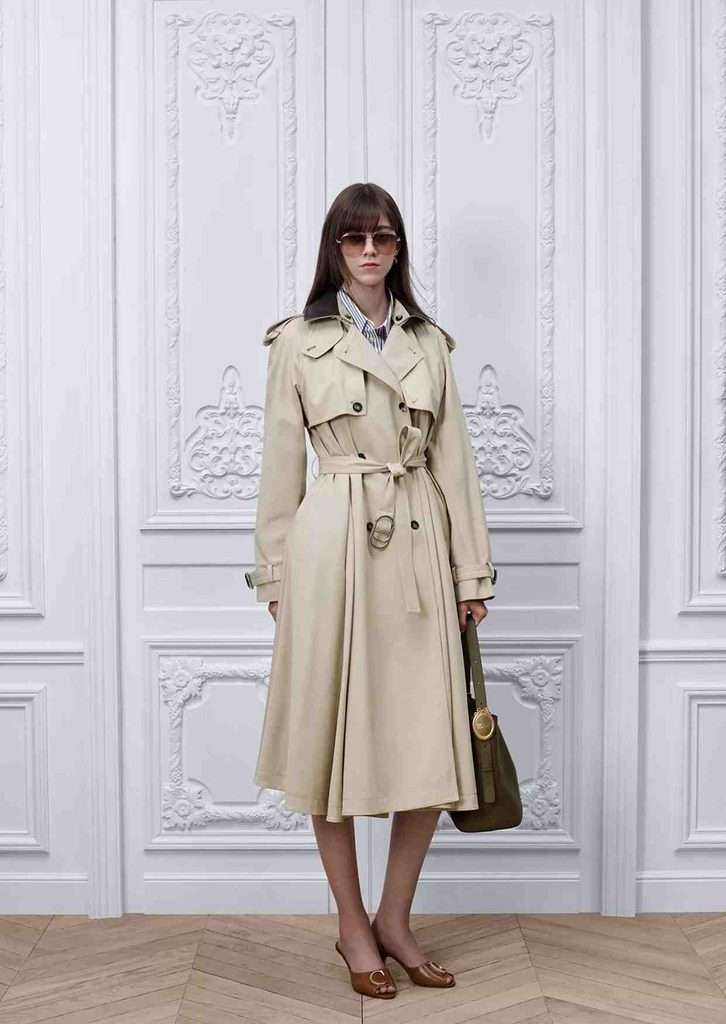
The trench is a belted, double-breasted coat in gabardine, a tightly woven twill that sheds light rain. Nearly every detail began as equipment: D-rings on the belt, a storm flap across the shoulder, epaulettes and a gun flap. Burberry and Aquascutum both claim to have made the first one for British officers in the First World War, and the argument has never been settled. It suits almost everyone, and the belt gives it a waist on frames that want one. Knot the belt at the front or the back rather than buckling it, and turn the collar up against wind.
The Mackintosh for Proper Rain
A mac is a plain, single-breasted raincoat in rubber-bonded or coated cotton, named for the Glasgow chemist Charles Macintosh, who bonded rubber between layers of cloth in the 1820s. Its seams are bonded or taped rather than only stitched, which makes it waterproof where a trench is only water-resistant. The trade-off is breathability, since it holds warmth in as well as rain out. It suits anyone who walks to work in wet weather. Wear it with the collar up over tailoring, and keep it for the days that need it.
Peacoats, Duffles and Car Coats Are the Shorter Working Coats
Peacoats, duffles and car coats are the shorter coats, and all three were cut for people with a job to do in them.
The Peacoat for Short, Dense Warmth
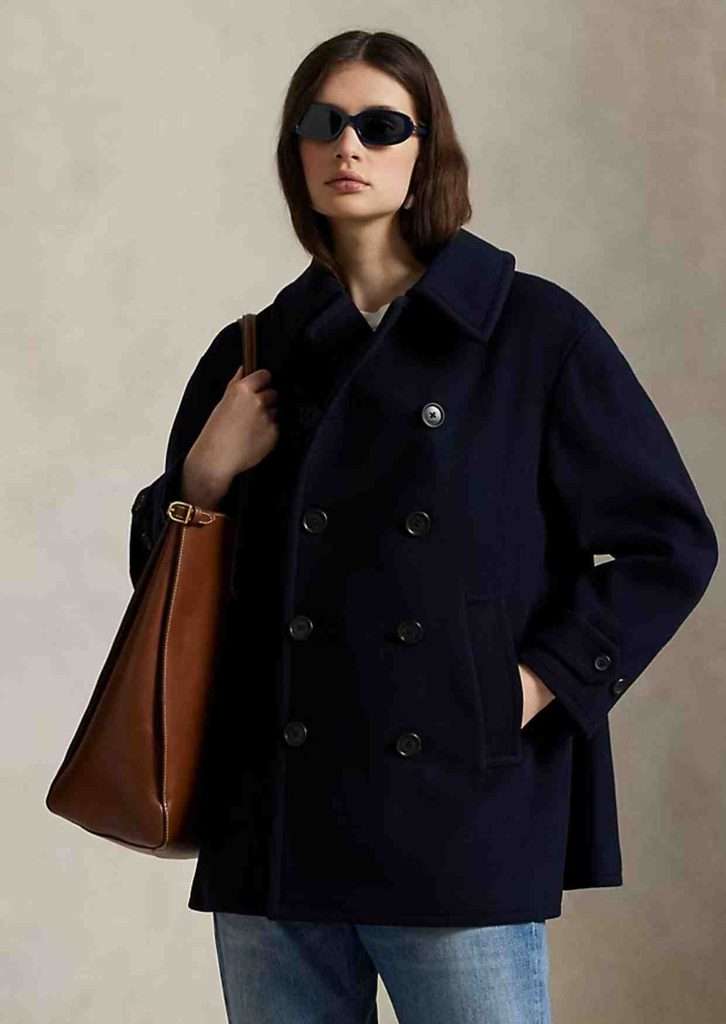
The peacoat is a short, double-breasted coat in heavy Melton wool, with wide lapels and vertical pockets, finishing just below the hip. Its heavy wool and short length made it practical for sailors on deck, and the dense cloth still shrugs off wind. It suits shorter frames and anyone who does not want a coat to hide their trousers. Wear it buttoned to the throat in wind, and put it over fine luxury knitwear, a roll-neck above all, because the cut leaves little room for anything thicker.
The Duffle Coat and Its Toggles
The duffle is a hip-length wool coat with a hood, patch pockets and toggle fastenings, named for the Belgian town of Duffel, whose thick woollen cloth it was first cut from. The toggles and loops were made to be fastened with gloves on, which is why they are so large. It is the least formal coat in this guide, and it suits anyone who likes a coat that looks lived in. Wear it with jeans or flannel trousers and a heavy knit, with the hood down in town, and keep it away from suits.
The Car Coat for Driving and Sitting Down
The car coat stops at mid-thigh, roughly halfway between a jacket and a three-quarter coat, with a flat collar and a straight, plain cut. It began as motoring dress, and its length means it does not bunch when the wearer sits behind a wheel. By the 1960s it was a staple of the male wardrobe, and in women’s fashion the name came to describe a cut, looser and always shorter than a traditional coat. It suits anyone who spends the day between a car, an office and a restaurant, a routine familiar across the Gulf. Wear it over tailoring with a pair of snug leather gloves for the wheel, and check that it covers the jacket beneath.
Parkas, Puffers and Shearling Coats Are Built for Real Cold
Parkas, puffers and shearling coats exist for temperatures that wool alone cannot manage, and each fights the cold differently.
The Parka for Wind and Wet Cold
A parka is a long, hooded, insulated coat with a windproof shell, usually closed with a zip under a storm flap. The type descends from Arctic cold-weather clothing, and Canada Goose, the Toronto maker, is its best-known name. It suits anyone who stands about outdoors in the cold, at a match, a market or a station platform. Cut it to go over a heavy knit rather than a jacket, and keep it for the trips and the mornings that need it, since it is too much coat for an office.
The Puffer Coat and How Fill Power Works
A puffer is a quilted coat in which stitched channels, called baffles, hold the insulation in place. The fill is traditionally down, and its quality is measured in fill power, the volume one ounce of down occupies: the higher the number, the more warmth for the weight. Moncler, founded in the French Alps in 1952, is the house most associated with the luxury puffer. It suits anyone who wants maximum warmth for minimum weight, and it packs small. Narrow baffles read closer to tailoring and wide ones read as outerwear, so choose by where you will wear it.
The Shearling Coat for Dry Cold
A shearling coat is cut from sheepskin tanned with the wool left on, so the wool lines the inside and the suede forms the outside. That construction blocks wind and holds heat, which is why shearling began as pilot clothing for open cockpits. Its weakness is rain, which marks suede. It suits anyone whose cold is dry, such as a Riyadh evening in January or a desert camp after dark, and it needs few layers beneath it. Wear it open over knitwear and let the collar be the one point of volume.
Cape, Teddy and Polo Coats Follow the Same Two Rules
Cape, teddy and polo coats are variations on the types above, and length and closure place them as easily as any other.
A cape coat has openings for the arms in place of sleeves, so it behaves like a wrap coat with more drama: wear it with narrow trousers and no bulk at the neck. A teddy coat is usually cut in a pile fabric that imitates the texture of shearling, with similar volume and less weather protection. The polo coat is a double-breasted, belted coat, traditionally in camel hair, closer to a wrap coat in feeling and to a trench in cut.
Wool, Camel Hair, Cashmere and Gabardine Behave Differently
The cloth decides how a coat wears, falls and ages more than the label does, so four are worth knowing.
Melton is a dense, felted wool that barely frays, which is why it goes into peacoats and duffles. Camel hair, the soft undercoat of the Bactrian camel, gives light warmth and a natural tan, and it marks easily, so brush it after wearing. Cashmere, the undercoat of cashmere goats, is softer again, and a blend with wool, as in many Chesterfields, keeps the softness and adds strength. Gabardine is a tight twill in cotton or wool that sheds light rain through its weave alone.
Care is the same for all four. Brush the coat after wearing, hang it on a wide, shaped hanger, and let it rest for a day between wears so the fibres recover.
Which Coat Should You Buy First?
Buy a single-breasted, knee-length coat in wool or a wool and cashmere blend first, in camel or navy, because it works over almost anything and at almost any occasion.
You might be thinking a trench is the safer first coat. In a mild or wet climate, it is, and the answer depends on where you spend winter more than on taste. Use these as a shortcut.
- If you wear tailoring most days, choose a Chesterfield or a Crombie.
- If your winters are mild or wet, choose a trench or a mac.
- If cold means the occasional trip, choose a parka or a puffer and keep it for travel.
- If your days run between car and meetings, choose a car coat.
Whatever the type, the fit rules hold. The shoulder seam should sit at the end of the shoulder bone, the sleeves should cover the jacket cuff, and the coat should button over the thickest layer you will wear beneath it. Length changes proportion as much as colour does, and the guide on how to dress for your body shape covers the reasoning.
Choosing a Coat for a Gulf Winter and Trips Abroad
For a Gulf winter, choose a coat that is unlined or lightly lined, in wool, gabardine or covert cloth, and keep one heavier coat for travel.
Dubai winter days run from roughly 20 to 30 degrees Celsius, and evenings can fall towards 15 in January, so a coat is an evening garment there rather than a daytime one. Riyadh and Kuwait are colder, and a desert camp after dark is colder still. Malls and taxis are kept cool, so a coat spends much of the day on your arm, and one that is heavy to carry is one you leave at home.
That points to the lighter types: a trench or a camel wrap coat for dinners outdoors, a covert coat for the cooler weeks, and a linen or cotton duster, the long, light coat cut for riders in dust, for evenings by the water. Keep the Chesterfield for Riyadh in January and for travel.
The heavier winter coat belongs to the December trip. A puffer compresses into a case where a wool overcoat will not, and a parka covers the cities that need one, such as Zurich or Sapporo. Dressing for Dubai covers the rest of the season’s wardrobe.
Start With the Problem the Coat Has to Solve
Every coat in this guide began as a solution: a saddle for the covert, a ship’s deck for the peacoat, a driver’s seat for the car coat, a gloved hand for the duffle. That is why the old names still describe real differences, and why the best-looking coat is rarely the best coat for you.
Work out what your winter actually asks for, cool evenings or the occasional trip somewhere properly cold, then choose the type built for it, in a shade from the autumn and winter colour trends. If you buy only one, make it the camel or navy overcoat, and add a trench for the shoulder months and a puffer for the trips.


