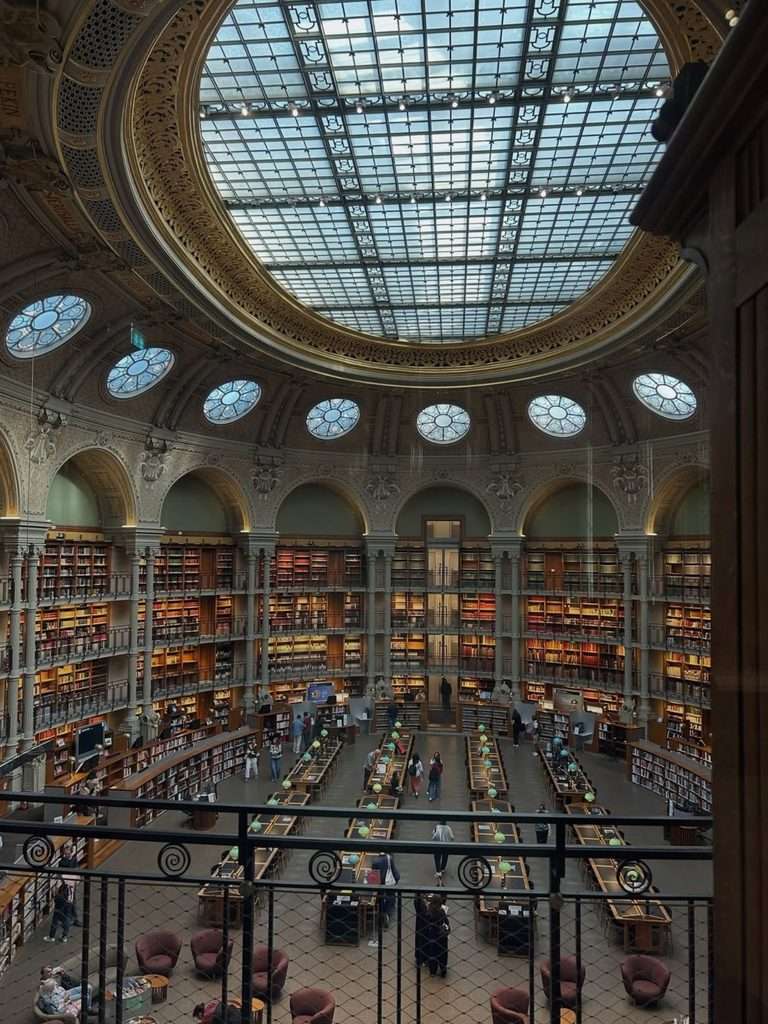

Memory, for children of diaspora, is often an inheritance gathered in fragments: letters, heirlooms and the stories carried across borders. In author Hooda Shawa’s September release, The Necklace of Seven Souls, that fragmented geography comes to life. Spanning Paris, Aleppo, Tangier and Haifa, the young adult novel follows two teenagers, Farida and Mazen, whose chance encounter at the Louvre sparks a search for a lost 1940s family portrait — unearthing an intertwined history rooted in art, survival and the unresolved echoes of the 1948 Nakba.
An Emirates Literature Festival favourite, Shawa understands this cross-cultural reality intimately. Born in the UK to a Palestinian father and an English mother, her childhood in Saudi Arabia was split between local Arabic schools and a home shaped by British and Arab traditions. Initially published in Arabic in 2019 as My Palestinian Sitti, the novel found a second life when Shawa partnered with translators Sawad Hussain and Nour Juljuli to evolve the narrative for an international English-language readership. Here, Shawa speaks with MOJEH about the role of grandmothers as guardians of history, transforming an Arabic text for a global stage and the responsibility of subverting Western tropes.
MOJEH: What inspired The Necklace of Seven Souls?
Hooda Shawa: My inspiration for The Necklace of Seven Souls comes from a lifetime of moving between East and West, and from my own Palestinian and English family histories. It grew out of my fascination with Palestinian grandmothers as carriers of memory.
My own paternal grandmother, my Sitti, was from Gaza. She was not displaced in 1948, but she was forced to leave her home after the Israeli invasion of Gaza in 2006 and never returned to her town of birth. She died in Amman. Her story, and the stories of so many other Palestinian women, made me think about grandmothers as keepers of keys, memories, photographs, stories and histories. Their storytelling becomes a way of preserving Palestinian collective memory and resisting cultural erasure.
The plot connects Paris, Aleppo, Tangier and Haifa. How does moving across these different landscapes shape the way Farida and Mazen process their inherited memory of the Nakba?
The movement between the different landscapes reflects the fragmented geography of Palestinian memory and diaspora. Farida and Mazen come from different family histories, but both are living with an inheritance shaped by displacement. Farida has fled the conflict in Syria with her parents and is now trying to establish herself as an artist in Paris, while Mazen, who was educated in London, arrives in Paris searching for a portrait of his grandmother Laila, painted in the 1940s by the English artist William Dixon. Their meeting in the Louvre brings these seemingly separate histories together.
Paris becomes the place where the two teenagers encounter one another and begin to uncover the connections between their families. It is also significant that they are exploring these histories away from Palestine. The physical distance allows them to investigate the past from the perspective of young people who have inherited a history of displacement without having necessarily experienced the Nakba themselves.
Aleppo and Tangier broaden that sense of displacement beyond Palestine itself. These places become part of the geography through which Palestinian and Arab histories have travelled, while Haifa represents a particular point of origin and loss.
You chose to write for young adults and teenagers. What made Young Adult Fiction the right medium to explore historical displacement?
I was drawn to Young Adult because young people are often at precisely the point in their lives when questions of identity and belonging become especially urgent. I wanted to explore these questions through characters who are discovering that the stories they inherit from their families can shape who they become, but do not necessarily have to determine their futures.
When my own daughters were at school in Kuwait, they came home with backpacks full of English-language Young Adult books by authors such as Roald Dahl and Jacqueline Wilson. I became increasingly aware of the absence of equivalent Arabic stories. I felt very strongly that children should be able to see themselves, their histories and their worlds reflected in the books they read. I wanted to write the books I wished I could have found in those school backpacks.

Tell us about the process of writing the original Arabic novel and then reimagining it in English.
Writing My Palestinian Sitti was deeply rooted in oral history: I listened to testimonies of Palestinian women and immersed myself in stories of displacement, dispossession, survival and resilience. What stayed with me most was the role of grandmothers as transmitters of history. Their stories preserve memories that might otherwise be erased, and their storytelling itself becomes an act of resistance.
When the opportunity came to translate the novel into English, the process began in 2024 with translators Sawad Hussain and Nour Juljuli. It was an exciting opportunity not simply to translate the Arabic text, but to revisit it.
The English edition became more than a straightforward translation. Through a series of conversations between the author, translators and editors, the novel evolved for an international English-language readership. We added chapters, developed new plot twists, and ultimately arrived at a new title, The Necklace of Seven Souls.
So the process was really a creative transformation rather than a simple transfer from one language into another. Revisiting the novel several years after its original publication allowed me to see the story differently and explore ideas and developments that had emerged since 2019.
How involved were you in ensuring the cultural nuances translated seamlessly into English?
Given the novel’s transnational geographic landscape, its cultural references vacillated across multiple diasporic places. I believe that an international readership assumes an acceptance of such a wide spectrum of cross-lingual elements. So, a reference to a Debussy piece of music in the novel is as much understood as a reference to the Syrian-Egyptian singer Asmahan.
What role does literary translation play in reclaiming regional narratives on a global stage?
Translation can open a door into stories that might otherwise remain inaccessible to readers who do not speak the original language. In the case of Palestinian and broader Arab literature, I think this is particularly important because so many representations of the region have historically been produced through Western frameworks.
Translation has the potential to shift who gets to tell a story and who gets to be heard. But it also needs to resist the temptation to flatten regional narratives into something easily consumable for an international audience.
How do you view the responsibility of an author when sharing stories rooted in the collective memory of the Middle East with a broader audience?
I think the responsibility is to resist simplification and to tell the story with honesty and complexity. There is a danger, particularly with histories of the Middle East, that stories are filtered through familiar stereotypes or reduced to narratives of conflict and victimhood.
I wanted the Palestinian characters in this novel to have lives beyond the historical trauma they inherit. Farida, for example, is an artist, and her relationship to art is central to her transformation. At the beginning of the novel, she participates in a kind of self-orientalism, conforming to a male-dominated art market that trades in a murky world of Orientalist fakes.
For me, telling a story rooted in Palestinian history also means allowing characters to be complicated, creative, flawed, ambitious and transformative. They should not exist simply as representatives of a political history.
What are you working on next?
A Young Adult fantasy fiction that weaves two mythologies, Mesopotamian and ancient Egyptian, into a contemporary novella that centres diaspora identity and ancient belief systems. Read The Necklace of Seven Souls here