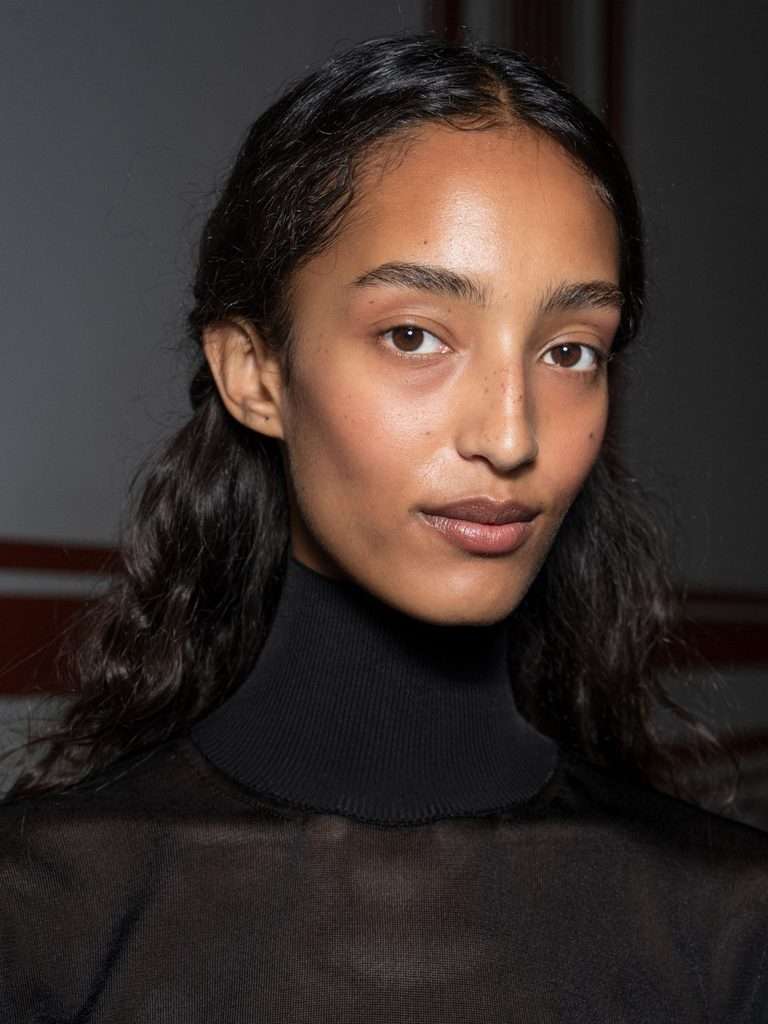

As September marks PCOS Awareness Month, MOJEH speaks to Shereen Abdulla, founder of organic women’s sanitary brand Adaye, on navigating diagnosis, rethinking everyday essentials and empowering women through cycle literacy.
MOJEH: What do you wish more women understood about PCOS?
Shereen Abdulla: That common and normal are not the same thing. So many of us carry symptoms for years simply because everyone around us seems to have them too, and we quietly decide that must just be how our body is.
I also wish someone had told me early that a clear ultrasound does not rule out PCOS. PCOS is diagnosed on two out of three criteria: irregular cycles, raised androgens on a blood test and cysts seen on a scan. Your ovaries can look entirely healthy and you can still have it. A great many women are told the scan looks fine and go home believing the conversation is closed. As things stand, girls tend to learn about PCOS only once they have it, which means we are always managing rather than avoiding.
PCOS is metabolic. It shows up in your energy, your weight, your skin and your hair, which is exactly why the condition was formally renamed PMOS, Polyendocrine Metabolic Ovarian Syndrome, earlier this year. Understanding that changes what you go and ask for.

As someone who has navigated the condition firsthand, what proved to be your greatest obstacle?
The uncertainty, without question. There is no single protocol for PCOS, and I do not think anyone tells you that clearly at the beginning.
What you are usually offered first is the option that is quick, easy and certain, and I want to be fair about that, because it genuinely helps a lot of women and I would never tell anyone to ignore her doctor. But I wanted to understand why my body was behaving the way it was, not only how to quieten the symptoms. And the path that made the most sense to me turned out to be the longer one, the harder one and honestly the one that felt more like a gamble.
You are making changes for months without knowing whether any of it is working, because the feedback loop in hormonal health is slow. And on top of it all, nobody around you is talking about it. I ended up teaching myself from books, podcasts and naturopathic practitioners. The hardest part was doing it without data to reassure me and without company.
What daily shifts made the most difference in managing your symptoms?
The change I can speak to with the most conviction is reducing my toxic load. Skincare, cleaning products, cookware and menstrual care all carry compounds that can interfere with oestrogen, and once you start reading labels properly, it is quite hard to unsee. I went through my routine and my home and swapped what I reasonably could. Period care was the one I could not solve by shopping, which is ultimately why I built it.
And the change that made every other change legible: I started tracking. Without that, you are relying on memory and hope, and you have no honest way of knowing whether what you are doing is working for your body specifically.
How did your personal experience pivot into the creation of Adaye?
After years of dealing with hormonal imbalances, PCOS and fibroids, I found myself frustrated that I could not find menstrual products that were both safe and effective for women like me.
The turning point came when I started understanding how much of oestrogen imbalance is driven by environmental toxins, the things we put on our skin and use around our homes without ever really questioning them. From there, I turned that same attention to period care. This is a product that sits against some of the most absorbent skin on your body, for around five days a month, for roughly forty years of your life. It is probably the most intimate, most repeated purchase a woman ever makes. And yet it was the one category where I could not find a single option in this region that I felt genuinely comfortable using.
Adaye came out of that gap. Not a Western brand shipped in and marked up, but organic period care created here, for women here, by someone who needed it herself.
What distinguishes Adaye from conventional options on the shelves?
What sets them apart comes down to three things. The first is what is actually inside them. Our pads are one hundred percent organic cotton through the top sheet and the core, not a cotton-feel layer sitting over a synthetic middle. No SAP, no wood pulp, no rayon, no fragrance, no dyes and no chlorine bleaching.
The second is proof. We hold GOTS certification, and rather than simply implying that organic cotton means everything else is fine, we verify what is not in the product through certificates of analysis. Phthalates and parabens are what women ask us about most, and they deserve an answer with evidence behind it.
The third is how it feels to buy and to use. Period care in this region has always been sold rather clinically, in a pharmacy aisle, in packaging designed to be hidden in your bag. We wanted it to sit closer to the rest of a woman’s self-care, because there is no good reason the most routine product of her month should be the one she is quietly embarrassed by.
Adaye recently teamed up with Clue and noon Minutes for a dedicated reset challenge. How did this partnership support women in regaining agency over their cycles?
Clue is one of the most trusted cycle tracking apps in the world. It is female-led, available in both English and Arabic and held to European data privacy standards, which matters enormously here.
We partnered with Clue, along with noon Minutes, on our 3 Month PCOS/PMOS Reset Challenge for PCOS Awareness Month. Because the philosophy of “what gets measured gets managed” helped me with my own symptoms, it was imperative that tracking sat at the heart of this programme. Cycle tracking matters especially for women with PCOS, since one of the symptoms is irregular cycles. Every participant receives three months of Clue Plus at no cost to log their period, mood, cravings and more indicators of where their cycle is.
The programme also features naturopathic guidance from Dr. Jawaher Kadhem, ND, delivered as digestible weekly lessons. Every woman who completes all three months earns a year of Adaye period care. It is not a competition; everyone who completes the challenge wins. We would rather women were accountable to themselves than measured against each other. Join the challenge